A Step Towards Justice: ICC to Deliver Judgement in the Said Case on 23 September 2026
Civil society organisations following the case have stressed its importance for victims and the fight against impunity, while expressing hopes that the proceedings will contribute to justice, reparations and recognition for affected communities. The African Francophone Coalition for the International Criminal Court has described the case as an important step for accountability in the Central African Republic and has called on the Court to demonstrate that those responsible for serious international crimes can be held to account.
The “Said case,” formally known as The Prosecutor v. Mahamat Said Abdel Kani, is the second case to be tried before the ICC concerning alleged violations of international human rights law committed in the Central African Republic II situation. The first CAR related case was The Prosecutor v. Alfred Yekatom and Patrice-Edouard Ngaïssona, both convicted by ICC Trial Chamber V of war crimes and crimes against humanity.
During the Closing Statements hearings, held on 25 and 26 November 2025, statements about the Said case were delivered by the Office of the Prosecutor, the Legal Representatives of Victims, and the Defence.
Civil Society has been closely following the case, each step of the way: "It is an important step in the fight against impunity in Africa in general and in the Central African Republic in particular. Mr. Said must answer for his actions. It is also an opportunity for Central African victims to obtain compensation for the enormous harm they have suffered” said Ali Ouattara, Coordinator of the African Francophone Coalition for the International Criminal Court.
This is a critical moment for justice to be served for the victims in the Central African Republic, and for the fight against impunity for war crimes and crimes against humanity. The Coalition for the ICC stands with the victims of human rights abuses and elevates the voices of Civil Society who continue to advocate for justice in CAR.
The Case Against Mr. Said
Mr. Said is alleged to be a former commander of Seleka, a militia group active during the CAR’s civil war. The scope of the trial pertains to war crimes and crimes against humanity allegedly committed by Mr. Said between 12 April 2013 and 30 August 2013 in Bangui, CAR.
These crimes include imprisonment or other severe deprivation of liberty; torture; persecution; cruel treatment and outrages upon personal dignity; and other inhumane acts. The crimes are associated with Said’s alleged role as a commander of the Seleka, a predominantly Muslim militia group active during the civil war in CAR that often launched attacks against rivalling Christian-majority groups.
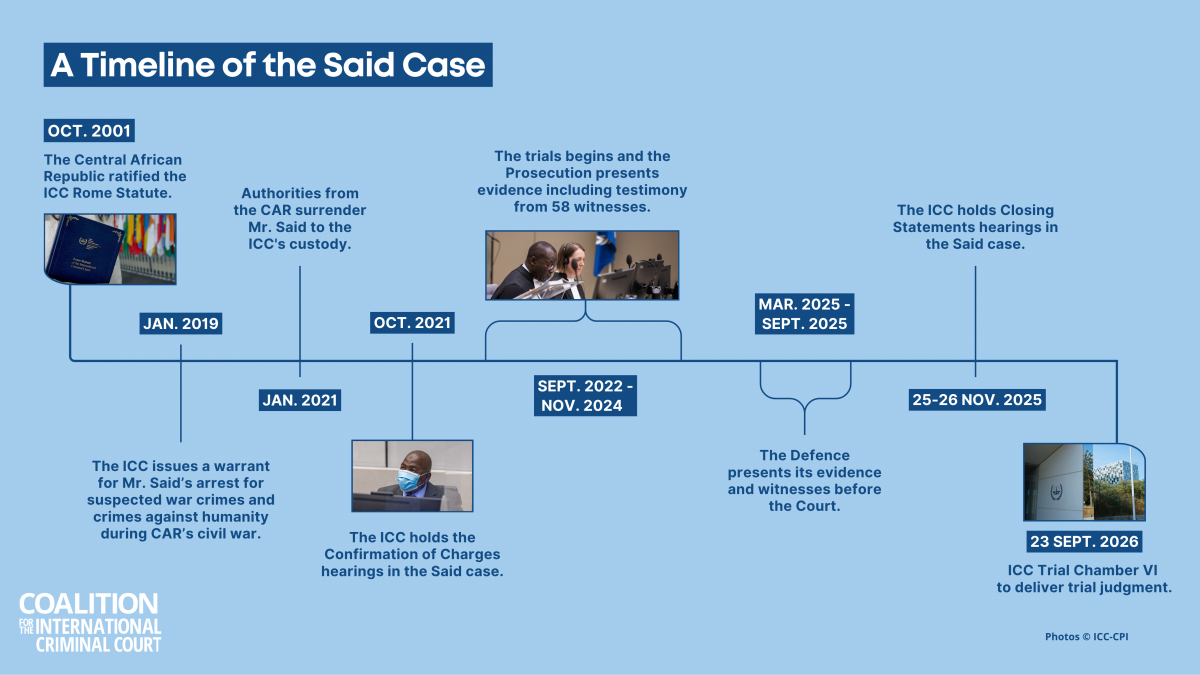
The warrant for Mr. Said’s arrest was issued under seal on 7 January 2019, and he was subsequently surrendered to the ICC on 24 January 2021. Following initial proceedings in the Pre-Trial Chamber, the confirmation of charges hearing was held from 12-14 October 2021, and the Chamber partially confirmed the charges on 9 December 2021. Nearly a year later, the trial opened on 26 September 2022, and the Prosecution concluded its presentation of evidence on 15 November 2024. The Defence presented its witnesses beginning on 17 March 2025 and concluded the presentation of evidence on 2 September 2025.
The Prosecution’s Argument
The Closing Statements hearings began on Tuesday, 25 November 2025 at the seat of the ICC in the Hague. The hearing was opened by Judge Miatta Maria Samba, Presiding Judge of Trial Chamber VI, followed by the Prosecution’s closing statements.
The Prosecution underscored the central role of evidentiary matters in the case. A main point asserted by the Prosecution was that based on the various testimonies presented by 81 witnesses before the Court, they have proved beyond a reasonable doubt that Mr. Said has committed the charged crimes.
The Prosecution also underlined the role of trauma in witness testimony. Trauma often makes it difficult for victims to recall certain details with complete clarity or consistency because of the way trauma affects the way memory is encoded; Judges were asked to remember this when considering the evidence presented by witnesses throughout the trial.
“The impact of trauma and the passage of time may have a contributing factor to a witness's recollection. Both these factors can be, your honours, a source of unclarity in the evidence that is given,” said Ms. Holo Makwaia, a Senior Trial Lawyer of the Prosecution.
The Prosecution also restated several key points made during the trial. For example, they argued that the persecution that was allegedly committed by Mr. Said and others in CAR relied upon discrimination based on intersectional identities, which identifies the organised nature of the crimes, according to the Prosecution. They also presented pictures of the inhumane conditions prisoners allegedly detained by Mr. Said and the Seleka faced.
“Mr. Said was in full command, was in full control [...] He was not a mere volunteer. He was not a mere support staff, as the Defence of Mr. Said would have you believe,” said Ms. Makwaia. The Prosecution urged the Court to take a holistic approach to the evidence, rather than a “piecemeal” approach, and asserted that the Chamber should find Mr. Said guilty of all charges based on the presentation of evidence.
A Chance for Victims' Voices to be Heard
As part of the proceedings during the Closing Statements hearings, the Legal Representatives of Victims are also able to make statements before the court. These statements were also heard on Tuesday 25 November before the proceedings ended for the day. The pursuit of justice for victims of international human rights violations is often a long and slow path. This is a critical opportunity to centre the victims of war crimes and crimes against humanity in the process.
The Representatives of Victims began by reminding the Court that victims in the Central African Republic await justice for crimes committed in 2013. “The victims have waited for more than a decade for their voices to be heard. They await the truth. They await recognition. They await justice,” said Sarah Pellet, the lead Legal Representative of the Victims.
“These victims were not combatants. They were not criminals. They were mere civilians – mothers, fathers, students – arrested, tortured, and in some cases killed, merely because they were perceived as opponents by the regime that emerged when the government was overthrown on 24 March 2013.”
The Representatives underscored the “fundamental” role that victims play in the ICC system and argued that this is not a symbolic role; victims have the right to be heard before the ICC, which was founded to prosecute the world’s worst international crimes. The Legal Representatives of Victims were critical of the Court’s exclusion of certain victims from the Central African Republic from the trial proceedings and argued against the sidelining of victims in the Court’s legal process.
“Even though the victims have been set aside, they still believe in this Court. They hope that you will hear their voices. They hope that you will recognize their suffering. They hope that you will render justice.”
Next step in the Path to Justice: The delivery of the trial judgment on 23 September 2026
The armed conflict in CAR has been characterised by grave human rights violations, and the Said trial offers an important avenue for holding perpetrators accountable and bringing justice to victims of violence. Healing and reconciliation can only happen when the truth is brought to light.
“Through this trial, African civil society in general, and the Coalitions of Francophone Africa for the ICC in particular, are placing their hopes in international criminal justice. No crime should go unpunished. The ICC must reaffirm its authority by prosecuting the perpetrators of these crimes, wherever they may be and whatever their nationality,” said the African Francophone Coalition for the International Criminal Court.
“We sincerely hope that justice will be done for the victims and that they will receive reparations. No matter how long it takes, crimes always end up being punished. This is therefore an opportunity to rebuild the Court's credibility.”
The Judgement will be read on 23 September 2026 at 11:00 at the ICC (CEST) and transmitted live through the ICC website. For more information: Order scheduling the delivery of the trial judgement ┃ Media advisory
The Judgement will determine whether the Prosecution has proven beyond reasonable doubt any of the crimes for which Mr. Said stands accused. If a guilty verdict on some or all of the counts is announced, the Court can either issue a sentence on the same day or wait to issue the sentence at a later time.
The CICC calls upon States Parties to:
-
Renew their support to victims and affected communities in the Central African Republic, including by supporting the work of civil society organisations and victims’ groups in the face of funding cuts and increased threats against civil society;
-
Call on CAR authorities and other actors to fully cooperate with the Court in ongoing investigations in both CAR situations;
-
Continue to fully cooperate with the ICC, on investigations, the search and surrender of suspects and signing cooperation agreements with the Court;
-
Provide the ICC with diplomatic support to deliver justice in all its investigations, in the context of attacks and threats against its work;
-
Provide full and timely financial contributions to the Court’s annual budget and maintain and increase contributions to the Trust Fund for Victims (TFV) as a concrete measure signalling support to victims.
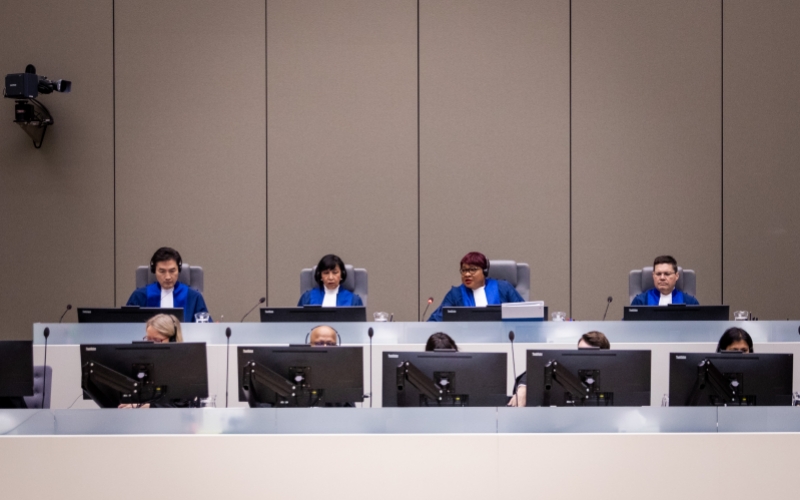
Picture: © ICC-CPI. The Closing Statements in the case The Prosecutor v. Mahamat Said Abdel Kani took place at the seat of the International Criminal Court (“ICC” or the “the Court”) in The Hague, The Netherlands, from 25-27 November 2025, commencing at 09:30 (The Hague time) in Courtroom 1.
