
ASP25: States Parties must turn support for international justice into concrete action
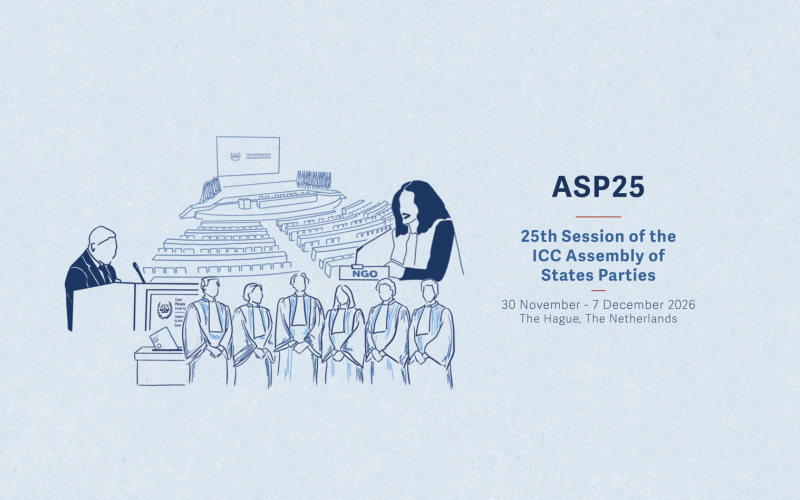
Institutional sanctions threaten essential services, arrest warrants remain unenforced, and civil society organisations face retaliation for pursuing accountability. For victims and survivors, these attacks threaten the prospect of justice itself. As States Parties prepare to gather for their annual session, they must turn their commitments to the Rome Statute into concrete protection, resources and cooperation.
At the same time, the Court and civil society organisations continue their work undeterred. Two trials are set to open in the Libya and Philippines situation, bringing long awaited justice to thousands of victims.
At ASP25, States Parties must demonstrate that their commitment to the Rome Statute is matched by the decisions, resources and practical measures needed to uphold it.
The fight against impunity under growing pressure
This year has demonstrated both the possibilities of international justice and the fragility of the conditions on which it depends. Proceedings in the Situations in the Philippines and Libya situations have brought long-awaited opportunities for victims’ voices to be heard. Civil society has continued documenting crimes, supporting survivors, and pressing for accountability. Yet these efforts take place amid sanctions, political interference, failures to execute arrest warrants, and financial pressures that threaten the Court’s ability to deliver justice.
The United States’ designation of the ICC as an institution on 9 October 2026 marked a major escalation in attacks already targeting Court officials and civil society organisations. The consequences extend beyond those directly sanctioned: restrictions on banking, technology and other essential services disrupt accountability work, while the threat of further measures discourages cooperation and isolates those seeking justice. Pressure on States Parties to reconsider their Rome Statute membership further threatens the system’s reach and their ability to uphold their commitments free from external coercion.
These attacks coincide with persistent failures to cooperate with the Court. Arrest warrants depend on States taking action, yet political considerations continue to obstruct their execution. The referrals concerning Italy and Tajikistan place a particular responsibility on the Assembly to ensure that judicial findings of non-cooperation receive sustained political and diplomatic follow-up. For victims and witnesses, failures to arrest and surrender suspects can prolong insecurity, deepen fears of reprisals and undermine confidence that engagement with the Court will lead to accountability.
At the same time, the Court must maintain investigations, conduct fair proceedings, protect witnesses and give practical effect to victims’ rights under growing financial and operational pressure. Its proposed 2027 budget must be considered against both its judicial workload and the additional demands of protecting staff, strengthening cybersecurity and maintaining essential services. Outreach, interpretation, legal representation and field engagement are equally necessary: proceedings cannot deliver meaningful justice if affected communities cannot understand, access or participate in them.
Against this backdrop, ASP25 is a critical test of States Parties’ willingness to give practical effect to their commitments. Decisions on the 2027 budget, the election of six judges, preparations for the next Prosecutor’s election and follow-up to non-cooperation will shape the Court’s capacity to withstand interference, maintain public confidence and fulfil its mandate in the years ahead.
Year-round civil society work informs the Coalition’s priorities for ASP25
The Coalition’s priorities for ASP25 emerge from year-round work by civil society organisations documenting crimes, supporting victims and survivors, monitoring proceedings and pressing governments to cooperate. Civil society organisations and human rights defenders around the globe undertake that work while confronting threats to their safety, shrinking civic space and constraints on their resources. Their participation at ASP25 brings this experience into the Assembly and helps identify where institutional commitments are falling short in practice.
The backgrounder calls for action across five connected areas. Above all, the Coalition calls on States Parties to:
Protect the Court and those who support its mandate: States Parties must respond collectively to sanctions, intimidation and political interference, while pursuing the full revocation of US sanctions without concessions affecting the Court’s independence, jurisdiction or investigations. Protection must extend to civil society organisations and human rights defenders targeted for their accountability work. The Coalition reiterates its call for the urgent adoption and activation of protective measures without delay, including national blocking legislation and extending the EU Blocking Statute’s protection to the relevant US sanctions, alongside practical arrangements to maintain essential services.
Reject any proposal to weaken the Court, restrict its jurisdiction, or suspend or sideline existing investigations: The Coalition for the ICC reiterates that there should be no compromise to the Court's jurisdiction. State Parties efforts should be focused on finding concrete solutions to ensure the ICC and those cooperating with it can continue to operate. Diplomatic engagements should focus on the immediate and unconditional revocation of the sanctions, without any compromise on the Court’s jurisdiction or independence.
Provide the resources required to deliver justice:. States Parties should approve a 2027 budget that is based on the Court's actual workload and operational requirements, rather than on predetermined nominal growth limits. Cybersecurity, business continuity and protection against coercive measures are integral to institutional independence. States must also safeguard sustained resources for outreach, language access, legal representation, victim participation and reparations, and pay their assessed contributions in full and on time.
Uphold merit, integrity and independence in elections: States Parties must elect highly qualified judges of high moral character, taking full account of the Advisory Committee on Nominations of Judges’ assessments and due diligence findings. They must reject vote-trading and reciprocal arrangements, and ensure that integrity concerns receive appropriate follow-up. At ASP25, States should also establish a sound framework for the next Prosecutor’s election, with rigorous due diligence, transparent procedures and meaningful civil society engagement.
Make victims’ rights effective in practice: Lessons from the Duterte and El Hishri hearings demonstrate the importance of accessible information, relevant languages, trusted legal representation and safe, dignified attendance. The Court should strengthen survivor-centered and trauma-informed practices, supported by adequate State funding. Victims’ ability to understand and engage with proceedings must remain a priority throughout investigations, trials, appeals and reparations.
Translate cooperation obligations into action: States Parties must execute arrest warrants consistently, engage promptly with the Court when difficulties arise and prevent political alliances from determining compliance. Referrals concerning Italy and Tajikistan require sustained, transparent Assembly follow-up directed towards restoring effective cooperation. Judicial findings must lead to practical responses that address failures and help prevent their recurrence.
The backgrounder also examines proposed Rome Statute amendments concerning slavery and the slave trade, ecocide and the crime of aggression, explaining their significance and the distinct processes through which States will consider them.
From advocacy to practice: #NGOVoices at ASP25
The annual ASP session is a pivotal moment for the Coalition and its members to engage with States Parties, Court officials and other actors, take stock of what has been achieved, and look ahead to how the international justice system can be strengthened and protected in the coming year.
Throughout ASP25, civil society organisations and human rights defenders from around the globe will bring evidence, recommendations and perspectives from victims, survivors and affected communities into General Debate interventions, engagement with state delegations and side-event discussions. Civil society will monitor elections and negotiations, scrutinise commitments, and share developments with members and communities following the session remotely.
In the margins of ASP25, civil society, States and the Court and other actors wiill organise multiple side events. Side events represent a unique opportunity to raise #NGOVoices around specific topics of mutual concern, including situations under investigation or preliminary examination, victims’ participation in confirmation of charges hearings, judicial and political developments related to the ICC and the ASP, threats and attacks against the international justice system, and other issues related to the ICC and the Rome Statute system.
On Monday 30 November, the event "Rodrigo Duterte on Trial in a Landmark Case before the ICC: Victims must not be left behind", taking place from 18:15-19:45 in Yangtze 1 at the World Forum, will bring together civil society, experts, victims' legal representatives, and members of the families who lost their loved ones to Duterte's so-called "war on drugs," to discuss what the beginning of a trial against former President Rodrigo Duterte before the International Criminal Court (ICC) means for victims and communities affected by the alleged crimes and for the future of international justice, and what can be done – by the Court and the international community - to make sure that no victims are left behind. This event is co-hosted by the Ateneo Human Rights Center (AHRC), Coalition for the International Criminal Court (CICC), European Center for Constitutional and Human Rights (ECCHR), Initiatives for Dialogue and Empowerment through Alternative Legal Services (IDEALS), International Federation for Human Rights (FIDH), Philippine Alliance of Human Rights Advocates (PAHRA), Philippine Coalition for the International Criminal Court (PCICC), REDRESS, and the Global Initiative Against Impunity (GIAI).
On Wednesday 2 December, from 13:15 to 14:45 in Europe 1&2, Court officials, the designated Palestinian organisations and other international experts will address States Parties directly on the consequences of the sanctions for their work and for victims and will invite States to consider concrete measures to protect the Court, its officials and civil society cooperating with it. The side event "Sanctioned for Seeking Justice: The US Campaign Against the Court and Palestinian Civil Society Cooperating with it" will also examine what the campaign means for the sovereign right of States to remain party to the Rome Statute, and for the integrity of the international legal order as a whole. This event is co-hosted by State of Palestine and the Republic of South Africa, together with Al-Haq Organisation, Al Mezan Centre for Human Rights, the Palestinian Centre for Human Rights, Amnesty International, the Coalition for the ICC, International Federation for Human Rights (FIDH), European Centre for Constitutional and Human Rights, the Australian Centre for International Justice, Democracy for the Arab World Now (DAWN), the International Association of Democratic Lawyers and No Peace Without Justice.
On Thursday 3 December, from 13:15 to 14:45 in Yangtze 1, members of affected communities including victims and survivors, civil society, international and national practitioners, and other experts will convene for the "Victim-centered and Trauma-informed Hearings" side event, examining how hearings at the ICC and national transitional justice mechanisms are experienced by those most affected by Rome Statute crimes. This event is co-hosted by the Victims' Rights Working Group, the International Federation for Human Rights (FIDH), the Coalition for the International Criminal Court (CICC), Redress; All Survivors Project; Synergy for Justice; and sponsored by Austria, Finland, France, South Africa and United Kingdom.
The side event "International Justice Under Attack: The Impact of Sanctions on Human Rights Defenders, Victims, and the Shrinking Civic Space" will convene human rights defenders, survivors and civil society representatives from Palestine, the Philippines, South Sudan, the US and Venezuela for a discussion aiming to highlight the impact of sanctions and other attacks against the Court on their work, the civic space, freedom of expression and freedom of association. This side event will explore how these attacks affect their work and the victims and survivors of mass atrocities they work with and for, and the role of states in support the Rome Statute system. The event will take place on Friday 4 December from 13:15 to 14:45 in Yangtze 1, and is co-hosted by Ireland, the State of Palestine, South Africa, the Coalition for the International Criminal Court (CICC) and the International Federation for Human Rights (FIDH).
Details of side events and supporting resources are available through the Making Justice Work events calendar. Access to events at the World Forum requires ASP25 accreditation or an approved day badge; an event invitation alone does not grant entry.
Commitments must lead to sustained action
The civil society's work informing this backgrounder will continue after the Assembly closes. The Coalition and its members will continue scrutinising implementation after the Assembly closes, following up on commitments and identifying where further action is needed. The measure of ASP25 will be whether its decisions strengthen the Court’s independence, enable meaningful participation and bring accountability closer to victims and survivors.
States Parties must leave ASP25 with measures they are prepared to implement: protection against coercion, resources that meet the Court’s needs, credible elections and effective responses to non-cooperation. Victims and survivors must be able to see the consequences of those commitments in practice.
Further resources:
official wepbage of the 25th ICC ASSEMBLY OF STATES PARTIES session
CICC INFORMATION HUB ON THE 2026 ICC JUDICIAL ELECTIONS
