
ICC confirms all charges against Khaled El Hishri and commits first Libya case to trial
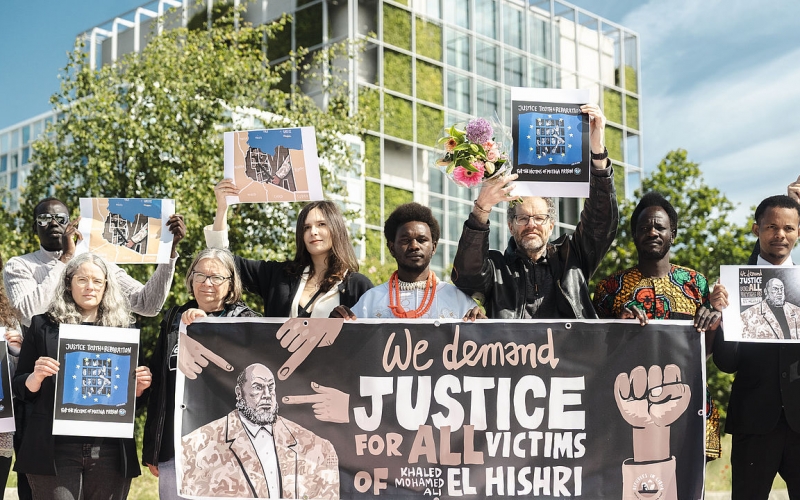
On 16 July 2026, Pre-Trial Chamber I of the International Criminal Court unanimously confirmed all 17 charges brought against Khaled Mohamed Ali El Hishri and committed him to trial.
The judges found substantial grounds to believe that Mr El Hishri is responsible for 17 counts of crimes against humanity and war crimes allegedly committed against people detained at Mitiga Prison and elsewhere under the control of the prison’s leadership between 1 May 2014 and 30 June 2020.
“This decision marks a historic milestone in the pursuit of justice in Libya, paving the way for the first trial before the ICC concerning grave international crimes committed in the country,” highlights Libya Crimes Watch. “It also offers victims and survivors a long-awaited opportunity to have their voices heard and pursue justice.”
“At a time when the ICC faces mounting political pressure and sustained attacks against its independence, the Court’s first Libya case moving to trial underscores the importance of preserving an independent system of international justice capable of prosecuting perpetrators of mass atrocities”, states Alison Smith, Executive Director of the Coalition for the International Criminal Court. “Mr El Hishri was surrendered to the ICC after being arrested by German authorities, illustrating the importance of state cooperation to ensure justice for victims. Justice cannot depend on political convenience: States must protect the Court from interference, respect their international obligations and fully cooperate, so that victims and survivors are not denied their right to justice.”
What the Chamber decided
At the confirmation of charges stage, ICC judges assessed whether the evidence establishes substantial grounds to believe that the suspect, in this case Mr El Hishri, committed the crimes charged by the Office of the Prosecutor (OTP).
The Chamber stressed that confirmation proceedings are not a “mini-trial” [1] and that many matters, including the credibility of witnesses and the final probative value of the evidence, can be conclusively determined only at trial.
The Chamber unanimously confirmed all 17 charges of crimes against humanity and war crimes allegedly committed between 1 May 2014 and 30 June 2020. These include torture, outrages upon personal dignity, rape, sexual violence, enslavement and murder of a number of persons detained in Mitiga Prison, and persecution, by targeting detainees of Mitiga on the basis of their political or religious views, their perceived position in society, or on the basis of their ethnicity, race or gender.
The Chamber also confirmed several alternative and cumulative forms of individual criminal responsibility.[2] It found substantial grounds to believe that Mr El Hishri personally committed alleged crimes, exercised authority and influence throughout Mitiga Prison, directly controlled its Women’s Section and acted jointly with other members of the prison leadership. The Chamber further confirmed allegations that he ordered or induced crimes, assisted their commission and contributed to crimes committed “by a group acting with a common purpose.”[3]
Allegations of an institutionalised system of abuse
“The decision recognises the gravity and breadth of alleged crimes committed against Libyan and non-Libyan detainees, including migrants and refugees, and brings survivors an important step closer to access to justice, truth, and reparation,” emphasises Refugees in Libya.
"My greatest excitement and fulfilment come from the fact that I continued to place my trust in the ICC to uphold truth and justice on my behalf," says David Yambio, founder and Executive Director of the survivor-led organisation, Refugees in Libya. "That trust came with an unwavering commitment in the face of the mental, physical, and psychological trauma I had to relive over and over again. In as much as my trust in the Court continues, I hope that this will not stop with El-Hishri - but will go on to hold EU actors accountable."
In confirming the charges, the Chamber found substantial grounds to believe that the alleged crimes were not isolated incidents. The Chamber referred to a pattern of violent arrest, interrogation, arbitrary detention, invasive searches, torture, sexual violence, forced labour, discriminatory treatment and inhumane detention conditions affecting a very large number of people over more than six years. It found that the alleged acts were carried out in an organised, coordinated and consistent manner pursuant to an organisational policy. It concluded that they formed part of an organised and institutionalised system of detention and mistreatment and a widespread and systematic attack directed against a civilian population.
A significant step for victims and survivors
The decision is especially important for victims and survivors who have sought accountability for alleged crimes committed at Mitiga Prison.
The Chamber acknowledged the contribution of 63 individuals who provided witness statements, including 47 former detainees. The judges noted that “Many of these survivors expressed how difficult it was to find the right words to describe the pain and suffering they endured at the hands of the perpetrators. Their recorded testimony constitutes the core of the evidence presented by the Prosecution in support of the charges, and therefore forms the basis for the present decision which confirms the charges and commits Mr El Hishri to trial” (Paragraph 2 of the Decision on confirmation of the charges against Mr Khaled Mohamed Ali El Hishri, ICC-01/11-01/25-1432, 16 July 2026). “The trial against El Hishri could bring victims one step closer to accountability and open the door to court-ordered reparations for the harm they endured at the hands of El Hishri,” highlights REDRESS.
“This is an extraordinary achievement for survivors who continue to fight to have the full reality of Mitiga recognised, in particular the enslavement and persecution of migrants and refugees,” says Allison West, legal advisor at the European Center for Constitutional and Human Rights (ECCHR). “Accountability must not stop at the walls of Mitiga prison. The Prosecutor must now investigate the wider system that brought people into detention and kept it operating, including the role and potential criminal responsibility of EU and Member State decision-makers.”
Civil society organisations have been at the forefront of documentation efforts of international crimes committed in Libya, including at the Mitiga Prison and have played a key role in the proceedings against El Hishri. “The involvement of Libya Crimes Watch, Lawyers for Justice in Libya, Refugees in Libya and many others in documenting war crimes and crimes against humanity, identifying victims, providing legal analysis and conducting outreach to affected communities, illustrate the essential role of civil society organisations in accountability efforts,” underlines Zoe Paris, CICC Advocacy Coordinator.
Cooperation and accountability beyond one case
As ECCHR underscores: “Outstanding arrest warrants must be respected by ICC States Parties and Libyan authorities, including for Osama Elmasry Njeem, whose current conviction in Libya does not eliminate the authorities’ obligation to cooperate with and surrender him to the ICC to instigate further proceedings.”
The Coalition reiterates that all States Parties must fully comply with their obligations under the Rome Statute. Libyan authorities and other states should cooperate with the Court, execute outstanding arrest warrants and ensure the protection of victims, witnesses, civil society actors and others who may face intimidation or reprisals because of their engagement with accountability processes.
The El Hishri case also illustrates a broader reality at the heart of the ICC system: without state cooperation, international justice cannot function. ICC States Parties serve as the Court’s enforcement pillar: the Court relies on States Parties to execute arrest warrants, transfer suspects, protect witnesses and facilitate investigations. In this case, proceedings only reached this stage because Germany arrested and surrendered Mr El Hishri pursuant to an ICC warrant.
Furthermore, under the United Nations Security Council Resolution 1970 (2011), which referred the situation in Libya to the ICC, and Libya's 2025 declaration accepting the Court's jurisdiction from 2011 to 2027, the Libyan authorities are required to cooperate fully with the Court. As a court of last resort, the ICC exercises jurisdiction only where national authorities are unwilling or unable genuinely to investigate and prosecute crimes within its jurisdiction.
“Libyan authorities should support the proceedings and surrender remaining suspects in Libya to the court, demonstrating that they are genuine partners in ending the impunity that continues to fuel atrocities across the country,” warns Alice Autin, international justice researcher at Human Rights Watch. “Libya should not shield ICC fugitives in defiance of its international obligations. With no signs of improvement in Libya’s deeply flawed justice sector, the ICC remains essential to deliver a measure of justice for victims of serious crimes committed in the country since 2011.”
"Accountability in Libya cannot remain a distant promise for victims and survivors,” underlines Nour Nassif, The Hague Representative of the Coalition for the International Criminal Court (CICC). “Without prompt and effective cooperation, investigations stall, courtrooms remain empty, the fight against impunity persists, and ultimately, victims are the ones who lose out. Nearly fifteen years after the UN Security Council referred the situation in Libya to the ICC, victims and survivors still deserve meaningful justice, and we owe it to them to continue this pursuit."
What happens next
On 20 July 2026, the ICC Presidency constituted Trial Chamber VII, which will be in charge of the case against El Hishri. Trial Chamber VII is composed of Presiding Judge Althea Violet Alexis-Windsor, Judge Miatta Maria Samba and Judge Beti Hohler.
The Chamber will hold status conferences, confer with the parties and participants to set the date of the trial and adopt the procedures necessary to facilitate the fair and expeditious conduct of the proceedings.
The Prosecution and Defence do not have an automatic right to appeal the confirmation decision but may seek the Chamber’s authorisation to do so.
The confirmation of all 17 charges is a historic step for the ICC’s Libya situation, but it is not the conclusion of the justice process. The forthcoming proceedings must be conducted fairly, independently and efficiently, with full respect for the rights of the accused and the safety and meaningful participation of victims and witnesses.
After fifteen years of limited judicial progress in the Libya situation, the El Hishri case shows what becomes possible when judicial work, survivor engagement and state cooperation come together. Its broader significance will depend on the fairness and effectiveness of the trial, sustained cooperation with the Court, the execution of outstanding arrest warrants and continued efforts to address impunity for international crimes in Libya.
“The prosecution of Mr El Hishri comes at a critical moment for Libya,” underscores Jürgen Schurr, Director of Programmes at Lawyers for Justice in Libya. “The Court and State Parties must continue to support civil society working with victims in and outside Libya to ensure that the proceedings in the Hague do not stay in The Hague, but resonate in and with the people in Libya, and help turn the tide of over a decade of impunity.”
Footnotes
[1] Paragraph 48 of Decision on confirmation of the charges against Mr Khaled Mohamed Ali El Hishri, ICC-01/11-01/25, 16 July 2026 (see page 19/84)
[2] Paragraph 132 of Decision on confirmation of the charges against Mr Khaled Mohamed Ali El Hishri, ICC-01/11-01/25, 16 July 2026 (seepage 46/84)
[3] Pagragraph 134 of Decision on confirmation of the charges against Mr Khaled Mohamed Ali El Hishri, ICC-01/11-01/25, 16 July 2026
