New sanctions against the ICC President and a staff member: States Parties must act now
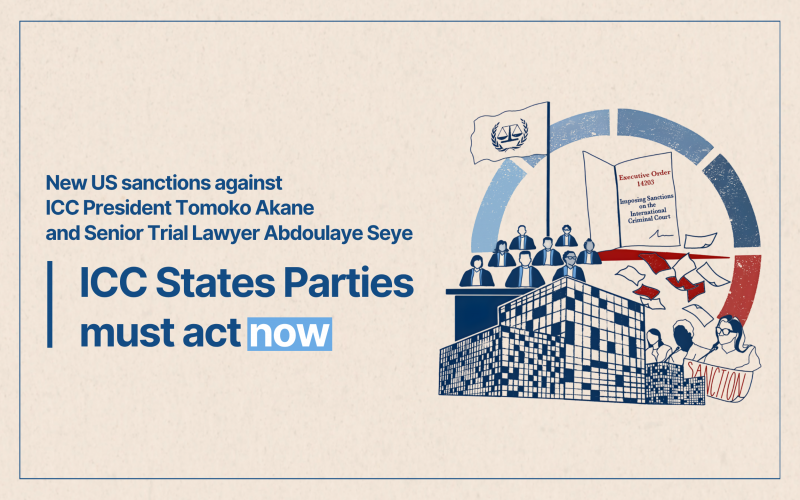
These latest designations mark a deeply concerning escalation in the sustained US campaign against the International Criminal Court and those working to advance international justice, ultimately to the detriment of victims. They follow sanctions against the former ICC Prosecutor, both Deputy Prosecutors and eight judges, as well as the UN Special Rapporteur on the situation of human rights in the occupied Palestinian territory and four Palestinian human rights organisations.
Sanctions threaten judicial and prosecutorial independence and the safety of those working on justice
Both designations are a blatant attack against the independence of justice and the rule of law. Sanctions are now reaching across the Court’s functions, from its highest judicial leadership to staff directly engaged in investigations and prosecutions.
The designation of President Akane is a direct attack on judicial independence. In December 2025, the US explicitly sanctioned Judges Gocha Lordkipanidze and Erdenebalsuren Damdin for their votes in an Appeals Chamber decision on Israel’s appeal on the investigation into the Situation in Palestine. President Akane was the third judge signing the majority decision. While the US has not publicly identified her participation in that judgment as the basis for her designation, all three judges who formed that majority are now subject to US sanctions.
Abdoulaye Seye’s designation is equally alarming. Targeting staff performing investigative and prosecutorial work is a clear attempt to obstruct the day-to-day conduct of investigations and the independent exercise of the Prosecutor’s mandate. Yet, as Deputy Prosecutor Niang has made clear, those attacks have no effect on the Court’s prosecutorial policy: “If a policy can be bent because of sanctions, then you cannot call it a policy. Our prosecutorial policy remains what it is.”
These designations are an affront to the basic principles that judicial and prosecutorial actors must be able to apply the law freely and independently, without fear of coercion, intimidation or reprisal. Judge Lordkipanidze reminds everyone that applying the law selectively due to the threat of sanctions or other external pressure would affect “the whole raison d’être of the ICC of having one single notion of justice for everybody. There cannot be different justices. There is one justice for all.”
States should ensure independent elections and relocate ASP25 to The Hague
Sanctioning Seye, Senegal’s nominated candidate for the 2026 ICC judicial elections, sends a chilling message to other candidates.
Seye’s designation also makes the planned location of the 25th session of the Assembly of States Parties (ASP25) in New York untenable. The 2026 ICC judicial elections are due to take place at ASP25 in December, with roundtable discussions with all candidates scheduled for early November in New York. A judicial candidate nominated by a State Party is now sanctioned by the State in which that election is scheduled to take place. Designated individuals have been unable to travel to the US, even for official United Nations functions; in January 2026, for example, Deputy Prosecutor Khan was not granted a visa to travel to UN Headquarters in New York to brief the UN Security Council on the Darfur investigation. Seye is likely to face the same barrier. As such, Seye’s ability to participate freely, safely and on equal terms in the judicial elections is directly at stake.
The Coalition has already warned that sanctions, visa restrictions and the increasingly restrictive environment in the US jeopardise safe, inclusive and meaningful participation at ASP25. The Assembly cannot defend judicial independence in principle while allowing coercive measures to determine who can participate in its proceedings or on equal terms in elections. Holding judicial elections in a country that has sanctioned a nominated candidate risks precisely that outcome. States Parties have both the responsibility and the means to protect the system they created: the Presidency and Bureau must now do the necessary to relocate ASP25 to The Hague.
The impact extends far beyond those sanctioned
Sanctioned officials and human rights defenders have faced frozen or closed bank accounts globally, restrictions on essential services and barriers to travel, impacting their lives and the lives of their families. Additionally, civil society organisations have faced funding cuts and lost access to essential services, impacting their operations and, ultimately, the victims they serve.
The Coalition’s 2026 report Criminalising Accountability documents how the consequences of sanctions extend far beyond the individuals formally designated, thereby impacting the entire Rome Statute system. Continued escalation and the unpredictability of who may be targeted next have created a chilling effect across the international justice sector, leaving Court officials, judicial candidates, civil society organisations and others at risk of sanctions simply for pursuing justice and accountability for the gravest international crimes.
Ultimately, victims and survivors bear the consequences. "Every attempt to obstruct an investigation, impede a judicial function or force an organisation to step back is ultimately an attempt to put justice further out of reach for victims and survivors. Protecting accountability for the gravest crimes is not optional. It is a responsibility that States must defend, without hesitation," stresses Alison Smith, Executive Director of the Coalition for the ICC.
States Parties have an obligation to act immediately, and proportionally to the threat
Expressions of concern are no longer sufficient. The ICC is an institution created by its States Parties. Protecting its independence and effective functioning is their collective responsibility. States Parties cannot condemn attacks on the Court and civil society while failing to take the measures necessary to shield it, its officials and those cooperating with it from those attacks.
The Coalition calls on all States Parties, individually and collectively, to:
-
Publicly and firmly denounce the new US campaign and the unlawful sanctions against the International Criminal Court (ICC), its staff and officials, and organisations and individuals supporting its work;
-
Publicly and clearly oppose any initiatives aimed at weakening the Court and attempts to influence prosecutorial priorities, including efforts to sideline specific situations, such as Afghanistan or Palestine;
-
Continue to engage bilaterally with the United States Administration to call for the immediate revocation of existing sanctions, to prevent further designations, and immediately halt its campaign against the Court;
-
Immediately adopt and implement national and regional blocking legislation to strengthen sovereignty and the security of residents and nationals, and for the European Commission to immediately activate the European Union's Blocking Statute (Council Regulation (EC) No 2271/96);
-
Ensure designated individuals and institutions are not excluded from accessing essential services for their mandates and private use by engaging proactively with banks, financial institutions, IT companies and other service providers to reaffirm the unlawfulness of the sanctions, clarify that they should not be enforced extra-territorially, and call on providers to stop automatic compliance;
-
Find concrete measures to mitigate damage to civil society organisations that have lost funds or are at risk of losing funds due to sanctions imposed by the US administration;
-
Relocate ASP25 to The Hague and ensure that no judicial candidate, Court official, victim, survivor, human rights defender or civil society representative is excluded or disadvantaged because of coercive measures imposed by a non-State Party.
-
Not be swayed by political pressure or campaigns aimed at undermining the independence of the Court when exercising their voting rights in the ASP.
-
Continue cooperating fully with the ICC and comply with their international obligations, including by arresting and surrendering to the Court any person subject to an ICC arrest warrant, without selectivity.
